
TL;DR
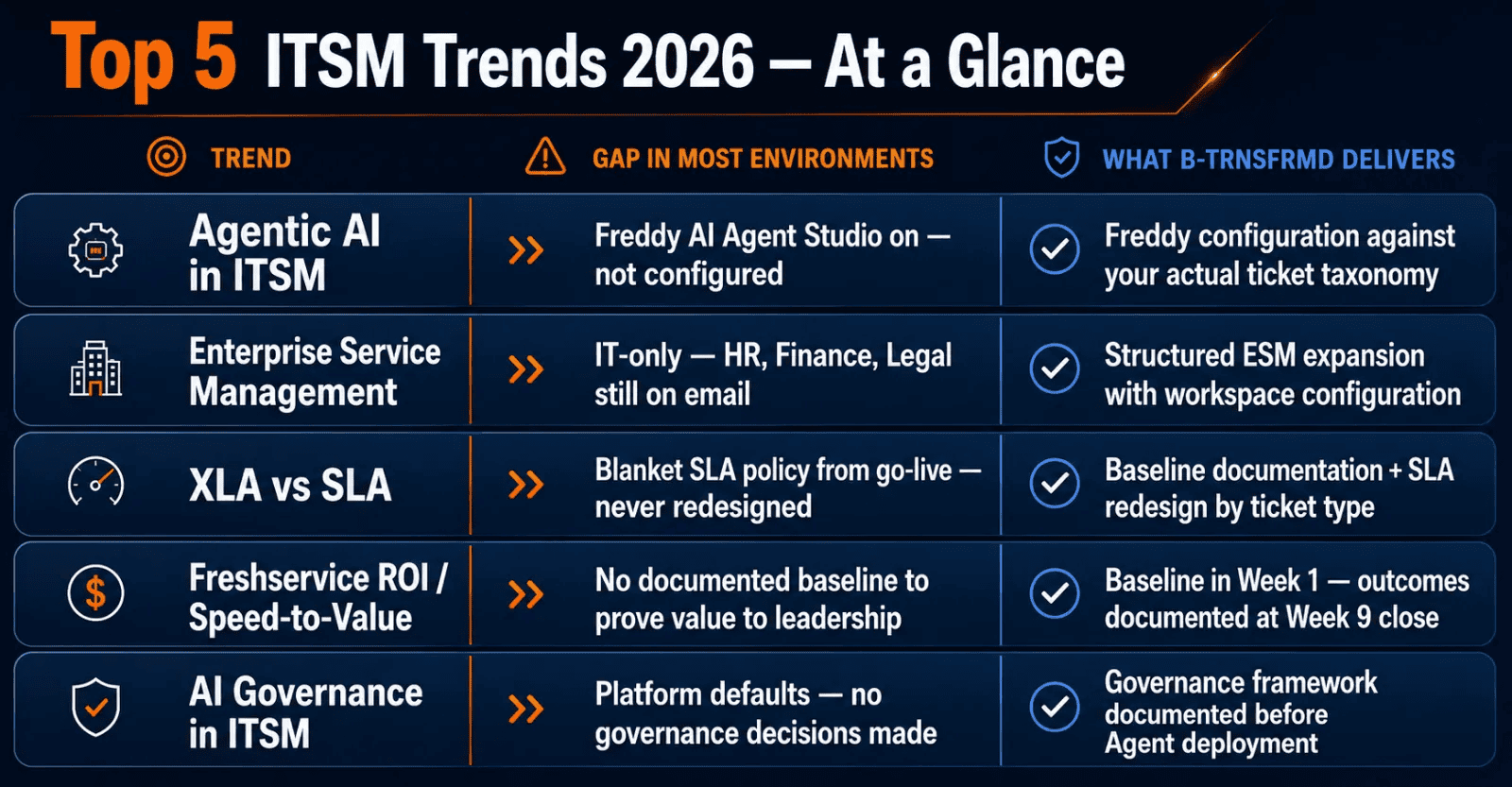
The top ITSM trends 2026 are already live in Freshservice. Most environments have configured for none of them. This blog covers what each trend means, what it requires from your environment, and what B-TRNSFRMD does about it.
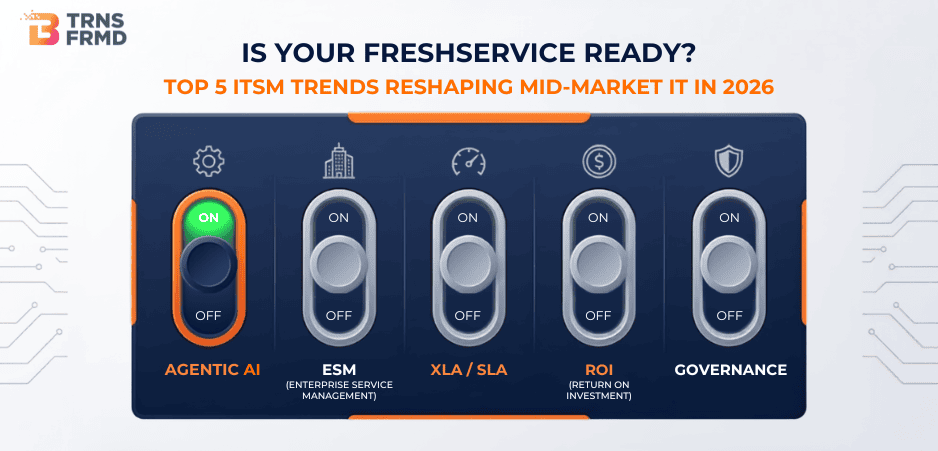
The top ITSM trends 2026 point in one direction: AI that acts — not just assists — and service management that extends far beyond the IT help desk.
For mid-market IT Directors managing Freshservice environments, these trends are not future considerations. They are configuration decisions available in your platform today.
As a certified Freshworks implementation and optimization partner, B-TRNSFRMD helps organizations close the gap between a live Freshservice environment and one that performs.
Here is what each trend requires — and what most environments are missing.
1. How Agentic AI in ITSM Is Changing Freshservice in 2026
What is agentic AI in ITSM?
Agentic AI in ITSM refers to AI systems that execute service management tasks autonomously — resolving tickets end-to-end, routing requests, and triggering workflows without waiting for human input at each step. Unlike generative AI, which assists agents with responses, agentic AI reasons, plans, and acts with minimal human intervention.
Where the market is right now
Nearly 75% of organizations are already using AI capabilities in their ITSM tools. 94% of those who can rate their results report efficiency improvements.
Early enterprise rollouts of agentic AI in ITSM are showing a 60% reduction in ticket volume — but only where three conditions exist:
- Knowledge base current and structured for AI consumption
- Ticket taxonomy granular enough for intelligent routing
- A named owner reviewing Freddy’s performance weekly
What Freshservice offers
Freddy AI Agent Studio — available in all Freshservice environments since Freshworks Refresh 2026 — gives IT teams a no-code environment to deploy 20+ pre-built agentic workflows or build custom AI Agents inside Microsoft Teams, Slack, and employee portals.
The capability is live. In most environments, the configuration has not started.
What B-TRNSFRMD does
We configure Freddy AI Agent Studio against your actual ticket taxonomy, knowledge base structure, and governance requirements — not platform defaults.
Most teams that come to us post-go-live have Freddy switched on and are producing no measurable deflection. The fix is a configuration engagement — not a platform change.
→ For a detailed breakdown of what keeps Freddy underperforming: Freshservice post-implementation optimization
2. What Is Enterprise Service Management And Why IT Teams Are Expanding Beyond the Help Desk
What is enterprise service management?
Enterprise service management (ESM) is the application of ITSM principles — structured intake, automation, SLA accountability, and reporting — beyond IT to HR, Finance, Facilities, Legal, and other business functions. ESM adoption is projected to grow at 14.20% CAGR through 2028.
The ESM opportunity inside your current Freshservice
In late 2025, Freshservice for Business Teams became available as a standalone product with pre-built workspace templates:
| # | Department | What Freshservice Covers |
| 1 | HR | Onboarding, offboarding, request management, approvals |
| 2 | Finance | Expense approvals, procurement, budget access |
| 3 | Facilities | Maintenance tracking, space management, automated workflows |
| 4 | Legal | Contract review, document requests, compliance tracking |
The expansion path is already in the platform you paid for. Most organizations have not used it.
What B-TRNSFRMD does
We implement ESM expansions as a structured engagement — mapping service request volume by department, configuring workspaces for each business function, and connecting each workspace to your existing approval and integration architecture.
Organizations that attempt ESM expansion without structured implementation typically replicate email-based processes inside Freshservice rather than redesigning them.
3. XLA vs SLA: Why Mid-Market IT Teams Are Moving Beyond Ticket Speed
What is the difference between XLA and SLA?
SLAs measure process completion — was the ticket resolved within the target time? XLAs — Experience Level Agreements — measure outcome and value: did the resolution actually help the employee?
| # | SLA | XLA | |
| 1 | Measures | Ticket resolution speed | Employee outcome and value |
| 2 | Answers | Did we hit the target? | Did we make a difference? |
| 3 | Risk | Green dashboards can hide broken service | Requires new measurement infrastructure |
| 4 | Best for | Operational governance | Leadership reporting and ROI proof |
Why SLA-only measurement fails in 2026
The watermelon problem: all the SLA dashboards show green on the outside. Cut it open and underneath are warning signs of poor employee satisfaction and rising resentment.
Employees who rate their IT experience positively lose 15 minutes per day to IT friction. Those who rate it poorly lose 52 minutes — a gap of over 3 hours per week, per person.
What Freshservice offers
Freshworks AI Insights measures resolution quality, experience trends, and employee satisfaction alongside traditional SLA metrics. Most environments have not enabled it.
What B-TRNSFRMD does
Our PATH TO OUTCOME™ methodology begins every engagement by establishing the baseline — resolution time, SLA compliance, deflection rate, Freddy AI acceptance — before any configuration begins.
We document it at the start. We measure against it at close. That is what makes XLA measurement possible.
→ For teams starting with CSAT: Freshdesk CSAT improvement and configuration guide
4. How to Prove Freshservice ROI to Leadership — The Speed-to-Value Shift in 2026
How mid-market IT buying decisions have changed
The three biggest challenges ITSM leaders face right now: demonstrating business value, adopting AI capabilities, and balancing cost-efficiency with service quality.
The question has shifted from:
“What features do I get?”
To:
“How quickly will this deliver value — and how do I prove it?”
Speed-to-value is a market behaviour shift, not a specific Freshservice feature. Freshservice’s transparent per-agent pricing, fast deployment, and built-in Freddy AI all contribute to a stronger speed-to-value story vs enterprise alternatives. The Forrester TEI study (Freshworks, 2023) documented 356% ROI over three years for fully configured environments — add the verified Forrester link before publishing.
4 questions most IT teams cannot answer
| # | Question | Why It Matters |
| 1 | What was resolution time before go-live — and what is it now? | No baseline = no proof of improvement |
| 2 | What percentage of tickets is Freddy deflecting? | If Freddy is not deflecting, the AI investment is invisible |
| 3 | Has cost per ticket moved since implementation? | The number leadership actually cares about |
| 4 | What is SLA compliance by business unit — not just aggregate? | Aggregates hide where service is genuinely failing |
If three or more are difficult to answer — the speed-to-value problem is already inside your environment.
What B-TRNSFRMD does
This is the OptimizeAI argument in market language.
Go-live is not the finish line. The configuration work in the first 90 days determines whether your environment produces measurable ROI — or a platform that runs but does not perform.
We structure those 90 days so outcomes are documented, not assumed.
If you’re heading into a renewal and can’t answer most of these — start with our free Renewal Readiness Checklist: Freshservice Renewal Readiness Checklist.
5. Freddy AI Governance in ITSM: Why Configuration Decisions Must Happen Before Deployment
Why AI governance is the ITSM trend most organizations are ignoring
In 2026, governance is not a procurement checkbox — it is an adoption gate. If your AI can do things, governance must prove it can do the right things, in the right way, with evidence.
The top three accelerants for agentic AI adoption in ITSM: clear governance frameworks (40%), improved AI literacy and change management (34%), proven ROI case studies from peer organizations (34%).
4 governance decisions every Freshservice environment must make
| # | Decision | Question to Answer |
| 1 | Autonomy scope | What does Freddy AI Agent handle end-to-end without human involvement? |
| 2 | Escalation triggers | What conditions cause Freddy to escalate to a human Agent? |
| 3 | Audit and logging | What does Freddy log for review and compliance? |
| 4 | Ownership | Who reviews Freddy’s performance weekly — and against which metrics? |
Most implementations leave all four at default. The Agent runs. Nobody reviews it. Performance drifts.
Six months later, someone asks why deflection rates have not moved.
What B-TRNSFRMD does
Every OptimizeAI engagement includes an AI governance review as a dedicated workstream — documenting Freddy’s autonomy scope, escalation triggers, and audit requirements before any Agent configuration begins.
It is the workstream most implementations skip. It is the one that determines whether agentic AI produces measurable value — or quietly becomes a capability nobody trusts.
What Do These 5 ITSM Trends 2026 Mean for Your Freshservice Environment Today
| # | Trend | Status in Most Environments | What B-TRNSFRMD Delivers |
| 1 | Agentic AI in ITSM | Switched on — not configured | Freddy AI Agent Studio configured for your ticket taxonomy |
| 2 | Enterprise Service Management | IT-only deployment | ESM expansion — HR, Finance, Legal, Facilities |
| 3 | XLA vs SLA | Default SLA policy from go-live | Baseline + SLA redesign by ticket type and business unit |
| 4 | Freshservice ROI | No baseline documented | Baseline in Week 1 — outcomes documented at Week 9 close |
| 5 | AI Governance in ITSM | Platform defaults throughout | Governance framework before Agent configuration begins |
What B-TRNSFRMD Delivers
B-TRNSFRMD is a certified Freshworks implementation and optimization partner.
We implement Freshservice from initial deployment through ESM expansion. We run OptimizeAI — a structured nine-week post-implementation engagement — for organizations already live on the platform.
Every engagement runs on our PATH TO OUTCOME™ methodology. Baseline documented before configuration begins. Outcomes measured and reported at close.
If any of the five trends above are gaps in your environment — that is the conversation worth having first.
→ Score your Freshservice environment in 10 minutes → btrnsfrmd.com/optimizefresh-scorecard/
→ See how the OptimizeAI engagement works → optimizefresh.com
→ Explore B-TRNSFRMD’s Freshservice practice → btrnsfrmd.com
Frequently Asked Questions
- What are the top ITSM trends in 2026?Agentic AI, enterprise service management, XLA adoption, speed-to-value buying, and AI governance. All five are already available in Freshservice. The gap is configuration, not capability.
- Is Freshservice suitable for enterprise service management?Yes — Freshservice for Business Teams launched as a standalone product in late 2025 with pre-built templates for HR, Finance, Facilities, and Legal. You do not need a new ITSM implementation to start. Teams already on Freshservice can extend from the same instance.
- Do XLAs replace SLAs entirely?No. XLAs and SLAs run in parallel. SLAs govern operational processes. XLAs measure whether those processes are actually delivering value to employees. Removing SLAs is not the goal — adding the outcome layer on top is.
- How long does it take to configure Freddy AI Agent Studio?It depends on knowledge base quality and ticket taxonomy complexity. A well-structured knowledge base and clear ticket categories can support a basic agentic workflow within the first few weeks of a structured engagement. Environments with stale content or broad categories take longer to prepare.
- What does a Freshservice post-implementation engagement cost?B-TRNSFRMD's OptimizeAI engagement is a nine-week structured program. Pricing is based on environment complexity and scope. The starting point is a free 30-minute assessment at optimizefresh.com — no obligation to proceed.