TL;DR
Salesforce has changed its pricing twice in about a year: a 6% average list increase in August 2025, then new Core ($195), Advanced ($395) and Max ($550) editions in September 2026. Legacy customers keep their current pricing, but the new editions now set the starting point for every renewal conversation.
Your real renewal cost goes beyond the quote. It’s five lines: subscription, AI usage, workflow and integration tools, admin time and consultant fees. Add them up early, then decide whether to renew, renegotiate, right-size or move.
Most renewal quotes arrive the same way. Finance forwards a PDF with one line on top: “Is this right?” And the honest answer, for a lot of CRM owners, is “I think so, but I can’t prove it.”
That gap is what this post is about. Not whether the latest Salesforce price increase is fair, but whether you know what you are actually paying for, and what else you could do with that money.
What Is Salesforce Renewal Cost?
Salesforce renewal cost is the total a company pays to continue its Salesforce subscription for another term: the per-user subscription, AI usage, the workflow and integration tools built around it, and the admin and consultant time that keeps it running.
Here is the catch. The quote on your desk covers the first part of that sentence. The rest sits in other budgets: an iPaaS contract in IT, a document-generation app on someone’s credit card, a consultant retainer under “professional services.” So when people say their Salesforce renewal cost went up 6%, what they usually mean is that one line went up 6%. The full number is often bigger, and nobody has added it up in one place.
That is fine when nothing changes. This year, a lot changed.
What Changed in Salesforce Pricing in 2025 and 2026?
Two things happened in roughly 13 months, and they landed differently depending on when your contract started.
August 2025: a 6% list increase
Salesforce raised list prices by an average of 6%, effective August 1, 2025, for Enterprise and Unlimited Editions across Sales Cloud, Service Cloud, Field Service and select Industries Clouds. Starter, Pro and Foundations editions were not affected. For context, the previous Salesforce price increase was in 2023: the company raised list prices by about 9% in 2023.
September 2026: new editions for new buyers
On September 3, 2026, Salesforce introduced Core, Advanced and Max editions for Agentforce Sales and Agentforce Service. For Sales Cloud, the list prices are:
| Edition | List price (per user, per month, billed annually) | What Salesforce says is included |
| Core | $195 | Slack Business+ and Tableau Next bundled in |
| Advanced | $395 | More AI capacity, plus added data and security features |
| Max | $550 | Same price as the earlier Agentforce 1 Edition |
Each edition also comes with a set amount of AI usage. Salesforce Ben reports Flex Credit allowances of 500,000 for Core, 1 million for Advanced and 2.75 million for Max. Industry editions follow later this fall.
The most important line for anyone renewing: Salesforce says customers on legacy editions keep their current pricing. So this is not an automatic Salesforce price increase on your existing contract. It does change the reference point, though. Third-party analysis from aliteq compares the new editions against legacy list prices of $175 for Enterprise and $350 for Unlimited. On list price alone, Core sits $20 above legacy Enterprise and Advanced sits $45 above legacy Unlimited, with more bundled in.
More bundled in is the part worth slowing down on. If your team already uses Slack and wants more AI capacity, that bundle may be good value. If they don’t, it is worth mapping which parts of the bundle your team will use. The new Salesforce pricing shifts the question from “how much per seat?” to “how much of this will we actually use?”
The Five Cost Lines Behind a CRM Renewal
When we sit down with a CRM owner before a renewal, we skip the headline Salesforce price increase for a moment and ask them to fill in five lines. Most can answer the first one in a minute. The other four take a week of chasing.
- The subscription. Per user, per month, times every license you pay for. Not just the ones people log into.
- AI usage or add-ons. Credits, AI SKUs and any usage beyond what your edition includes. This line is the hardest to forecast and the easiest to underestimate.
- Workflow and integration tools built around the CRM. Middleware, connectors, document generation, e-signature, scheduling, data sync. Each one has its own contract and its own renewal date.
- Admin and developer time. Salaries or contractor hours spent keeping flows, fields and reports working. Count the share of their time, not the whole salary.
- Consultant fees for changes. Every new process, field or report that needs outside help. Look at the last 12 months of invoices.
Add all five, divide by the number of active users, and you have a real per-user figure. In our experience, that number is the one that changes the conversation in the room, because it is usually well above the per-seat price on the quote.
| Want a quick estimate first?
Plug your user count and current edition into our calculator and see what the five lines could look like on one platform. |
What Do Workflow and Integration Tools Add to the Bill?
This is line three, and it is the one most renewal reviews skip.
Over the years, most CRMs pick up a ring of tools around them. Some were bought to fill a gap. Some came in with a project and stayed. None of them show up on the CRM quote, but every one of them depends on the CRM staying exactly as it is.
Two groups to look for:
- CRM workflow automation tools. Approval routing, document generation, e-signature, task assignment, lead routing. Ask whether each one is doing something your CRM could do natively today. Platforms move fast, and a tool you needed in 2021 may be redundant now.
- CRM integration services. Middleware and connector subscriptions that move data between the CRM and your ERP, marketing platform, contact center or data warehouse. These are often priced by volume or by connection, so they grow quietly as you add systems.
A useful exercise: list every tool that touches the CRM, its annual cost and its renewal date, on one sheet. Teams that do this for the first time are often surprised at how many separate renewals depend on the main one. If you want to see how we approach CRM workflow automation and integration on a single platform, that page walks through it.
Here is why this matters for the decision. If you are only comparing subscription to subscription, every alternative looks like a close call. Once lines three, four and five are on the table, the comparison often looks very different, in either direction.
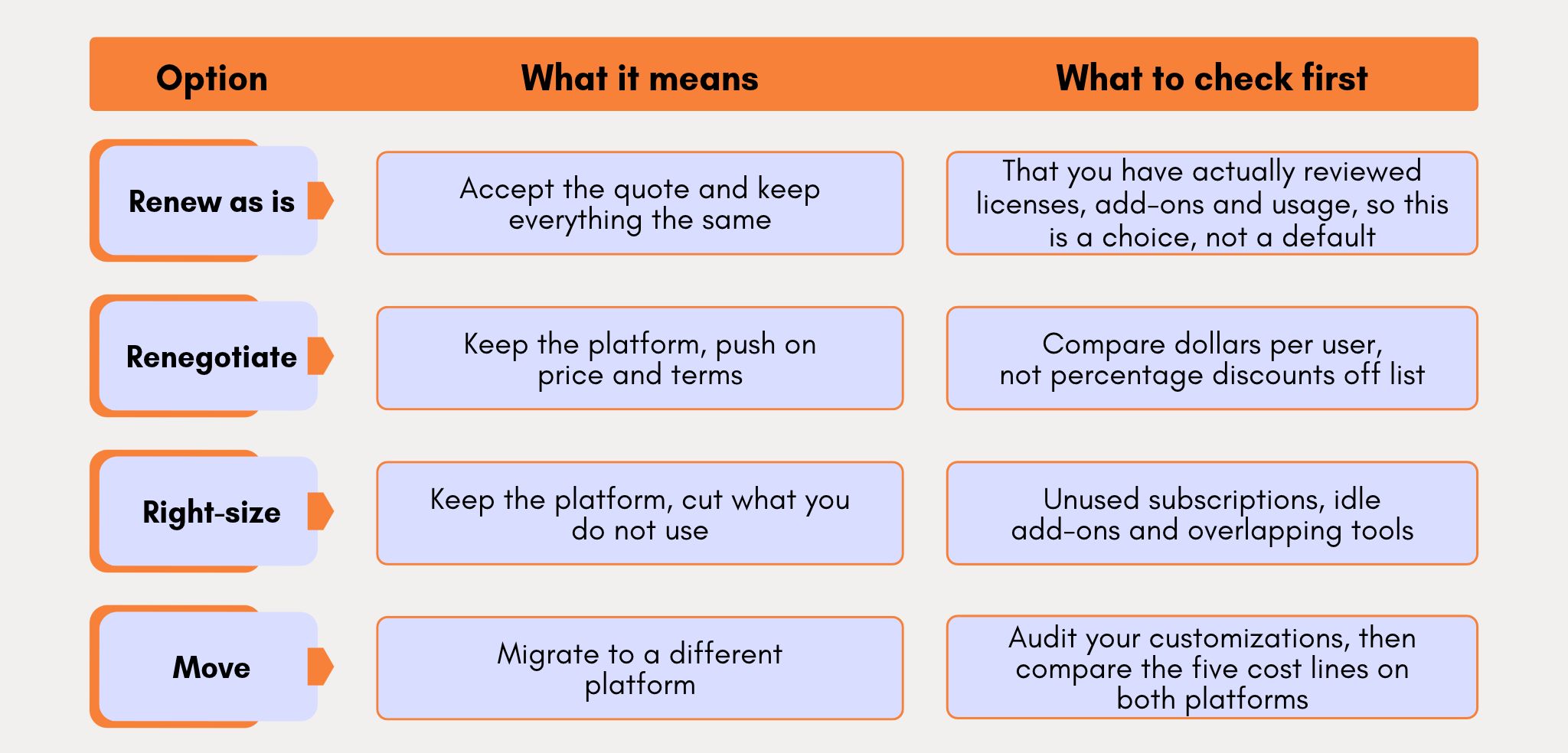
Renew, Renegotiate, Right-Size, or Move: Your Four Options
There is no single right answer here. There is a right answer for your contract, your team and your next three years. These are the four options, and what to check before you commit to any of them.
- Renew as is
Sometimes this is the right call. If the platform fits, adoption is strong and the five lines add up to a number you can defend, renewing keeps your team focused on the business instead of on a project. Just make sure it is a decision you made, not one the calendar made for you.
- Renegotiate
Salesforce pricing on paper is a starting point, and a Salesforce price increase on list does not have to become the same increase on your invoice. Licensing advisors recommend comparing absolute dollars per user rather than percentage discounts, because “25% off” means very different things depending on the starting list. Ask for add-ons, support and integrations to be itemized separately, so you can see what you are paying for each piece.
- Right-size
Pull a login report. Count licenses assigned to people who have left or who log in once a quarter. Check which add-ons are switched on but unused. Right-sizing rarely makes headlines, but it is often the fastest way to lower your Salesforce renewal cost without changing anything your users see.
- Move
Moving is the biggest decision of the four, and it should start with an audit, not a demo. Look at the customizations you have built over the years: what is still used, what is still needed, and what could be rebuilt in no-code tools. Then compare all five cost lines on both platforms, side by side. We are covering the customization question in detail next week.
What Does One Platform Look Like?
A lot of the cost in lines three, four and five comes from stitching tools together. So it is worth asking what changes when workflows, AI and integrations live on one AI CRM platform instead of across several: fewer CRM integration services to pay for, and less CRM workflow automation bolted on from outside.
Creatio is one example. It is a no-code AI CRM platform where business users configure workflows, forms and rules, and where AI is included in every plan instead of added on as a separate product. Nucleus Research reported that Creatio customers saw a 37% reduction in technology costs (April 2025; findings published by Creatio).
What that looks like in practice: one financial group we worked with moved five business units onto a single Creatio instance in seven sprints, rolling out one unit at a time, with 200+ workflows automated and 2M+ records migrated. The point is not that every company should move. It is that “one platform” is a real option to price, not just a slogan.
B-TRNSFRMD Consulting LLC is a certified Creatio partner, so we see these comparisons from the inside. Sometimes the numbers say move. Sometimes they say renegotiate and right-size. Either way, you should see them before you sign.
Questions To Ask Before You Sign
Print this, or forward it to whoever owns the contract.
- When is our renewal notice date, not just our renewal date?
- Which edition does our contract map to, and are we on legacy pricing?
- How many licenses are assigned, and how many people logged in last month?
- Which add-ons are switched on, and which ones does anyone use?
- How much AI usage did we consume last year, and what happens if we go over?
- What tools sit around the CRM, what do they cost and when do they renew?
- How many admin and developer hours went into keeping the CRM running?
- What did we pay consultants for changes in the last 12 months?
- What is our total across all five lines, divided by active users?
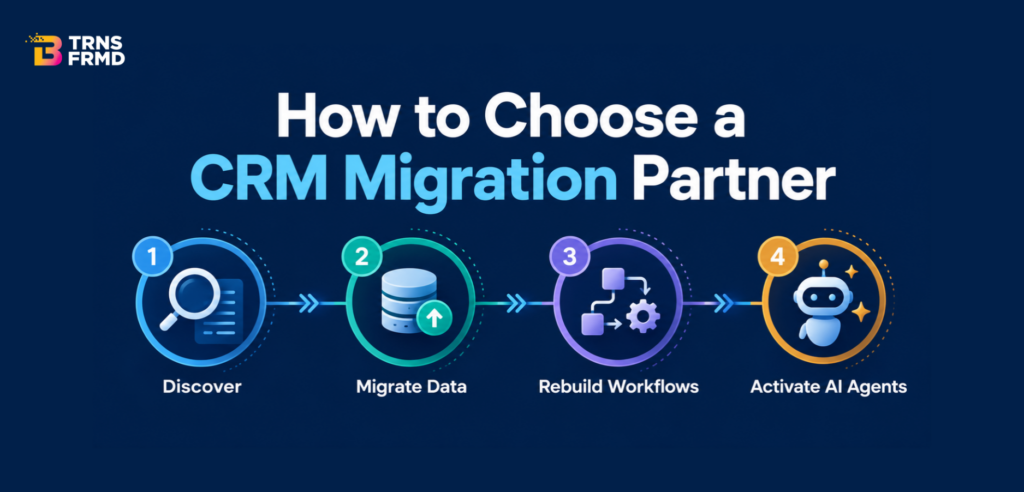
If we were choosing a CRM today, does our current setup still match where the business is heading? If you are weighing a move, our earlier post on how to choose a legacy CRM migration partner is a good next read.
How We Help: PATH TO OUTCOME™
At B-TRNSFRMD, our PATH TO OUTCOME™ approach starts with the outcome you need from your CRM, not with a platform. We map your five cost lines into one Salesforce renewal cost figure, review what your team actually uses, and lay out what renewing, renegotiating, right-sizing or moving would cost over the next three years. You leave with numbers you can take to finance, whichever way they point.
Book an assessment
Not sure whether to renew, renegotiate, right-size or move? Book a free assessment with the B-TRNSFRMD team. We’ll go through your renewal and your five cost lines with you, so you know which option makes sense before you sign.
Not ready to talk yet? Start with the AI-Native CRM Buyer’s Guide.
Frequently Asked Questions
- What changed in Salesforce pricing in September 2026?On September 3, 2026, Salesforce introduced Core, Advanced and Max editions for Agentforce Sales and Agentforce Service. For Sales Cloud, list prices are $195, $395 and $550 per user per month, billed annually. Salesforce says customers on legacy editions keep their current pricing, so check which edition your contract maps to before comparing.
- How much did Salesforce raise prices in 2025?Salesforce raised list prices for Enterprise and Unlimited Editions by an average of 6%, effective August 1, 2025, across Sales Cloud, Service Cloud, Field Service and select Industries Clouds. Starter, Pro and Foundations editions were not affected. Actual prices depend on discounts and negotiation, so every contract differs.
- What do the new Salesforce editions include?Salesforce says Core includes Slack Business+ and Tableau Next, and Advanced adds more AI capacity plus data and security features. Max keeps the earlier Agentforce 1 price of $550. Because more products come bundled, compare the full package against what your team uses before you accept a renewal quote.
- Can you negotiate a Salesforce renewal?Yes. List price is a reference point, and actual pricing depends on bundling, discounting and negotiation. Licensing advisors recommend comparing absolute dollars per user rather than percentage discounts off the list price, and asking for add-ons, support and integrations to be itemized separately.
- What costs besides subscription fees count at renewal?Count five lines: the subscription, AI usage or add-ons, the workflow and integration tools built around the CRM, admin and developer time, and consultant fees for changes. Total all five before you compare renewing, renegotiating, right-sizing or moving, so each option is judged against the same full number.
- How early should a CRM renewal decision start?Start well before the notice window in the contract, because comparing options, auditing customizations and planning a migration all take time. Find the renewal notice date first. A review that begins only weeks before the renewal date usually leaves renewing as the only practical option.