
TL;DR
- Creatio Agentic AI is built natively into CRM objects and workflows, with sales, marketing, and service agents available in the core product rather than sold as add-ons.
- An AI-native CRM 2026 buyer should expect agents that read and act on every record natively, not a chatbot stitched on through integrations.
- The gap between mid-market teams that get value from agentic CRM and those that abandon it comes down to implementation discipline, not the software itself.
IT directors at mid-market companies have heard the pitch for “AI-powered CRM” for three years running, and most of them have learned to discount it. The label got attached to features that amounted to a chatbot bolted onto a contact record, or a scoring algorithm that ranked leads without doing anything about them.
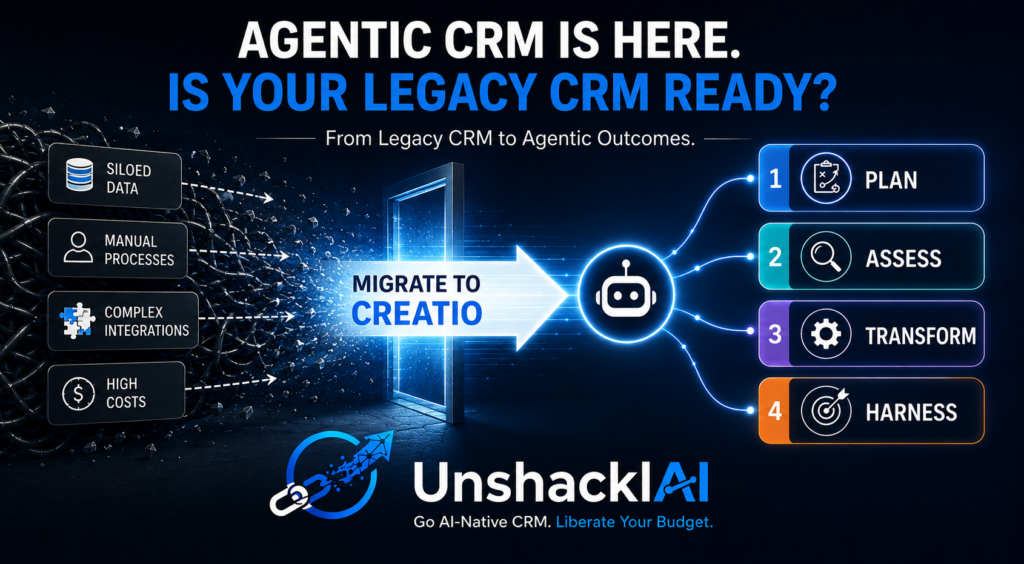
2026 is the year that skepticism gets tested against something with actual teeth: agentic CRM, where the system does not just surface a recommendation but carries out the next step itself. For a company running lean IT and RevOps teams, that distinction is not academic. It is the difference between paying for another dashboard and getting hours of manual work off someone’s desk every week.
This is what agentic CRM mid-market conversations should actually be about: fewer manual handoffs, not more software to babysit.
Why “AI in Your CRM” Means Something Different in 2026
For most of the last decade, “AI in CRM” meant predictive lead scoring, a generative email drafter, or a chatbot sitting on top of the support portal. Useful, but fundamentally assistive. A rep still had to read the recommendation and decide whether to act on it.
That model is being replaced fast. Gartner now projects that over 40 percent of enterprise applications will feature role-specific AI agents by the end of 2026, up from a fraction of that a year earlier, and the shift is showing up in CRM outcomes directly. Companies already running generative AI inside their CRM are 83 percent more likely to exceed their sales goals than those that are not.
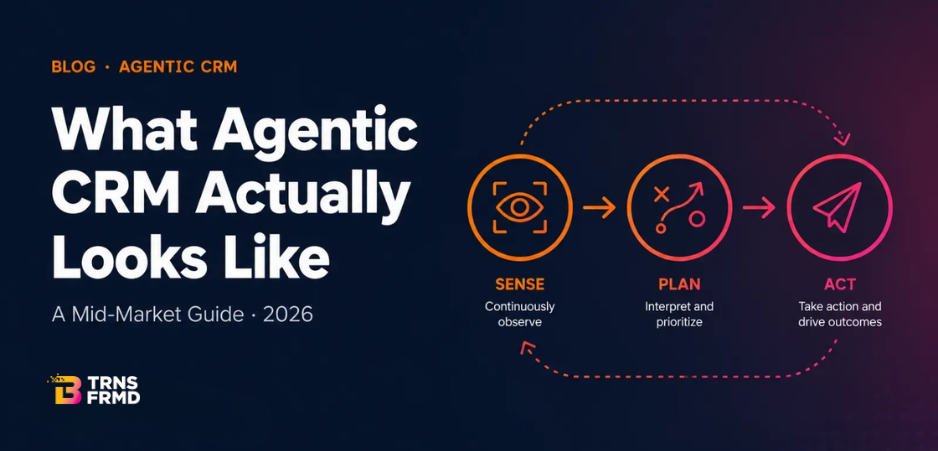
The practical difference is the sense-plan-act-reflect cycle. A generative feature answers a question or drafts a paragraph when asked. An agent perceives a change in the CRM, such as a stalled deal or an unassigned case, reasons about the right next step, takes that action inside the system, and then learns from the outcome.
That cycle is the actual definition of CRM AI automation in 2026, as distinct from the assistive features that carried the AI label a year or two ago. It is also why the term agentic CRM deserves more precision than most vendor marketing gives it.
The Difference Between AI on Top of Your CRM and AI Inside It
Most of the AI features mid-market companies have used to date were bolted on after the fact: a plugin, a sidebar assistant, a separate tool that had to be stitched into the CRM through integration work. That architecture has a ceiling, because the AI layer only knows what the integration exposes to it, and every new use case means another connector. It is also the opposite of what an AI-native CRM 2026 platform is supposed to deliver.
An AI-native CRM inverts that. In Creatio’s case, every data object, relationship, and business process is natively accessible to AI agents because the platform was designed with AI as part of the architecture rather than retrofitted onto a legacy data model. That is a meaningful distinction for a mid-market IT team evaluating vendors in 2026, because it changes what “implementation” actually requires. Instead of configuring integrations between a CRM and a bolted-on AI tool, the work becomes configuring which agents your teams need and what boundaries they operate within.
An AI-native CRM 2026 buyer should be asking vendors directly whether AI agents can read and act on every object in the system out of the box, or whether that access has to be built.
What Agentic CRM Looks Like in Creatio — Five Specific Capabilities
Creatio agentic AI is not a single feature. It is a set of role-specific agents plus a builder that lets business users create more of them. Five capabilities matter most for a mid-market deployment.
| # | Capability | What It Does | Why It Matters for Mid-Market |
| 1 | No-code agent builder | Business users compose agents visually by combining skills, workflows, and existing knowledge bases, with no developer required to ship a working agent | Determines whether agentic AI ships at all for an IT team without a dedicated AI engineering function |
| 2 | Sales agents that prepare and quote | A meeting prep agent assembles agendas, talking points, and account context ahead of a call; a quote agent recommends products and pricing and drafts the proposal itself | Acts on the sales pipeline directly instead of just annotating it |
| 3 | Marketing agents that write and route | Content agents draft campaign copy and blog material in a brand’s voice; lead conversion agents score incoming leads and route them to the right rep automatically | Removes manual triage and keeps leads out of a shared queue |
| 4 | Service agents that triage and draft responses | Reviews incoming cases, proposes a resolution path, and drafts the reply for a human to approve or send | Cuts the time between a case landing and a customer hearing back |
| 5 | Conversational workspace and dashboard agent | Users run multiple agent conversations in parallel, each with its own memory and role-based permissions; describing a dashboard in plain language gets it built, connected, and filtered | Applies CRM AI automation to reporting itself, not just customer-facing workflows |
What Mid-Market Teams Gain That Was Previously Enterprise-Only
Eighteen months ago, agentic capability of this kind was priced and architected for enterprise buyers. Two things changed that math for agentic CRM in a mid-market environment, and both trace back to Creatio agentic AI being sold as a core product feature rather than an enterprise upsell.
First, cost– Inference costs have dropped by a factor of 1,000 over three years, which is a large part of why production-grade agents are now financially viable for smaller deployments. Pricing reflects that shift directly.
Creatio’s core CRM products start around $15 to $25 per user per month with AI agents included at no additional license cost, compared with enterprise agentic platforms that start well above $500 per user per month for comparable agent functionality. That gap matters enormously to a finance leader signing off on a mid-market technology budget.
Second, the no-code agent builder removes the developer bottleneck that used to gate this kind of capability to companies with dedicated engineering teams.
A mid-market IT director configuring agentic CRM no longer needs to staff a build team to get a working agent live. That single change explains most of why agentic CRM mid-market adoption is accelerating faster in percentage terms than enterprise adoption, even though the absolute scale of enterprise deployments remains larger.
The Implementation Decisions That Determine Whether Agentic CRM Delivers
The software is not the risk. The rollout is, and that holds true whether the CRM AI automation in question comes from Creatio or any other vendor.
Research tracking adoption through mid-2026 found that enterprises are reaching fully scaled agent deployment at more than double the rate of mid-market companies, and mid-market abandonment rates remain comparatively high even as overall failure rates decline. The difference is not the budget alone. It comes down to a handful of decisions made before the first agent goes live.
- Data hygiene first. An agent acting on stale or duplicate records will act confidently and incorrectly. Cleanup has to precede automation, not follow it.
- Human-in-the-loop by design. Decide up front which agent actions execute automatically and which require sign-off, rather than discovering the answer after an agent sends something it should not have.
- Narrow scope before broad rollout. Deploy one or two role-specific agents against a well-understood workflow before expanding, rather than switching on every available agent in the same quarter.
- Adoption, not just activation. An agent nobody trusts gets routed around. Training and change management determine whether the agent gets used at all.
How B-TRNSFRMD’s PATH TO OUTCOME™ Applies to Creatio Implementations
Every one of those decisions is a project management problem before it is a technology problem, and that is where B-TRNSFRMD’s PATH TO OUTCOME™ methodology is applied on Creatio engagements.
The approach starts with an assessment of data quality and workflow maturity before any agent is configured, moves through a phased rollout that targets one function at a time, and builds the governance model and approval boundaries into the implementation plan rather than treating them as an afterthought. Measurement is built in from the start, so a client can see whether CRM AI automation is actually reducing manual work rather than assuming it is because the license is active.
This is the difference between an agentic CRM mid-market rollout that sticks and one that quietly gets abandoned six months in.
That structure is why the conversation with a client rarely starts with which agents to turn on. It starts with which process is costing the team the most hours right now, and works backward from there.
Frequently Asked Questions
- 1. What is an agentic CRM?Agentic CRM is where AI agents plan and execute multi-step tasks on their own, like drafting a quote, triaging a case, or building a dashboard, instead of recommending an action. It goes beyond generative AI features like email drafting or chatbots, since the agent completes the workflow. Creatio agentic AI shows what separates a true AI-native CRM 2026 platform from a bolted-on chatbot.
- 2. How is Creatio different from Salesforce for mid-market?Salesforce remains the more established option in mid-market by installed base, but Creatio's no-code agent builder and lower per-seat entry point make it a more accessible starting point for companies without a large existing Salesforce footprint or a dedicated development team. For an agentic CRM mid-market comparison specifically, that pricing and packaging gap is usually the deciding factor.
- 3. Does agentic AI require a developer to configure?Not in a Creatio environment. The no-code agent builder lets business users assemble agents visually from existing skills, workflows, and knowledge sources, and deploy them without writing code. Technical resources still add value for complex integrations or highly customized workflows, but a standard sales, marketing, or service agent does not require a developer to get live.
Ready to see what Creatio agentic AI, real CRM AI automation, and an AI-native CRM 2026 platform would actually look like inside your own environment?
Book a Free CRM Assessment to know more. For more insights on Creatio, Freshworks, and agentic CRM, visit B-TRNSFRMD.