
TL;DR
- Most CRM vendors now sell “AI.” Far fewer have rebuilt their platform around it.
- Test any AI CRM platform against four pillars: unified data, agents that act, no-code orchestration, and built-in governance.
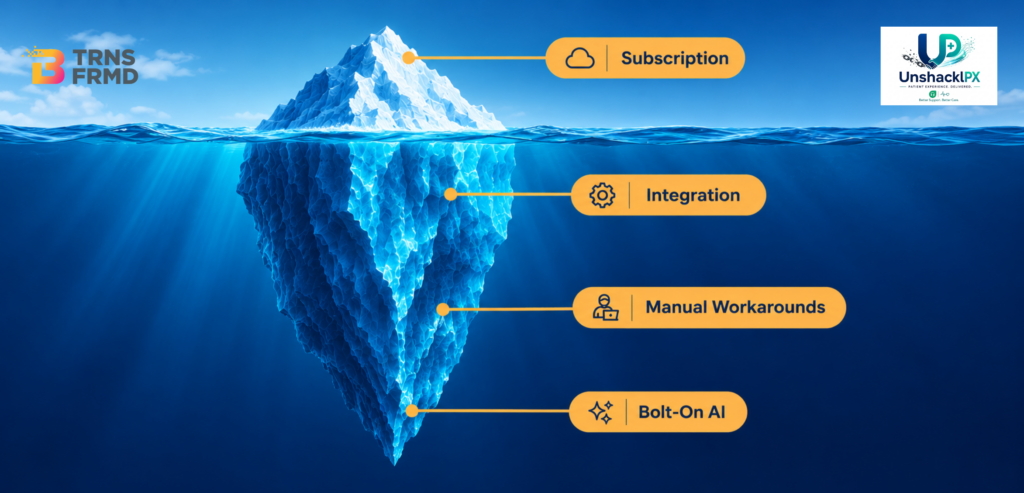
- License fees are the visible cost of a legacy CRM. Add-ons, developer hours, and slow response are the real one.
- With the right legacy CRM migration partner, switching runs in weeks without stopping sales or service.
Every CRM renewal deck this year has the same slide: an “AI” badge, a copilot screenshot, and a promise that your system is now intelligent. Much of it is not, and telling an AI-native CRM from an AI-washed one is now the most important call in any AI CRM platform renewal.
Gartner has a name for the problem: agent washing. It estimates that only about 130 of the thousands of vendors claiming agentic AI are delivering it. The gap rarely shows up in a demo. It shows up later, in add-on invoices and agents that suggest but never act.
What “AI-Native” Really Means for an AI CRM Platform (Hint: It Is Not a Chatbot)
An AI-native CRM is built so that AI works from the same data, rules, and workflows as your people. An AI-washed CRM bolts a copilot onto an aging data model and calls it transformation.
| Dimension | AI-Washed CRM | AI-Native CRM |
| Architecture | AI layered onto an aging data model | AI embedded at the data, reasoning, and action layers |
| What AI does | Suggests, summarizes, drafts | Executes workflow steps within guardrails |
| Data access | One record, fixed fields | Full history across sales, service, and marketing |
| Pricing | Per-feature or per-tier add-ons | Part of the core platform model |
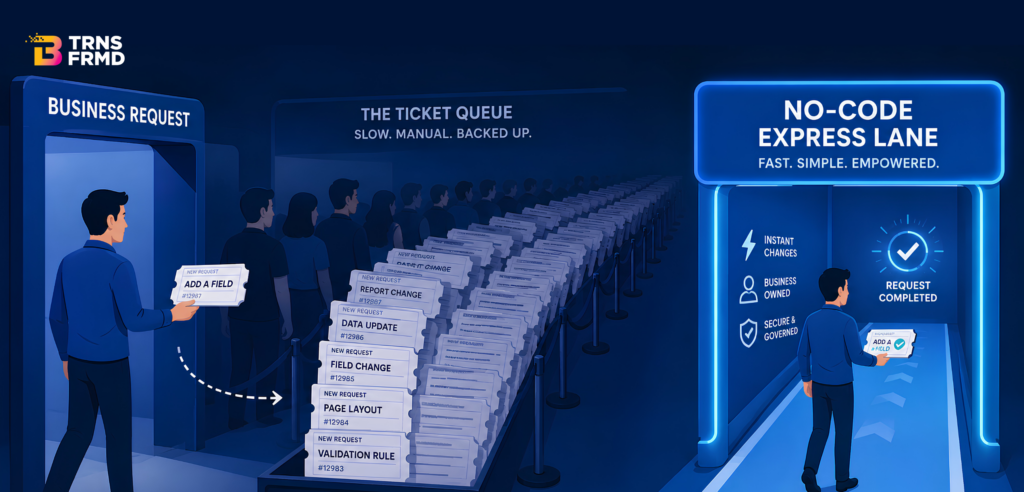
| Change speed | Waits on developers | Configured by business teams in no-code |
Analysts at Solutions Review put the defining test simply: can the agents carry out workflow actions on their own, or only produce suggestions for someone else to execute? If your AI CRM platform only suggests, it is an assistant. We unpack this distinction further in AI in Customer Service Is Not the Same as an AI-Native CRM.
The 4 Capability Pillars That Separate Real AI from a Shiny Badge
- Unified data.One customer record across every channel, with no middleware in between. If the AI needs a separate warehouse to see the full picture, it is always working with a lag.
- Agents that act.AI Agents should update records, route cases, and trigger approvals inside defined limits. Recommendations alone do not count.
- No-code orchestration.Business teams should be able to change how agents and workflows behave without a development sprint.
- Governance built in.Permissions, approval steps, audit logs, and explainability at the agent level.
A platform that clears three pillars is close. One that clears only one is a legacy CRM with a new label.
The Hidden Cost of Staying on a Legacy CRM (It Is Not on Your Invoice)
The license fee is the number everyone sees. The rest hides in other budgets:
- AI add-on tiers and usage-based agent charges
- Developer hours for every customization and upgrade
- Middleware and integration maintenance
- Shadow tools and spreadsheets that fill the gaps
- Slower lead response and lost conversions
The numbers add up. Nucleus Research interviewed organizations that moved from Salesforce and Microsoft to Creatio and found a 37% reduction in total cost of ownership, implementation up to 70% faster, and a 61% average drop in lead response time.
Most organizations have never itemized what staying actually costs them beyond the license. That gap is why B-TRNSFRMD built UnshacklAI. A good legacy CRM migration partner should hand you that full number before renewal, not after.
Questions Your CRM Vendor Hopes You Will Not Ask About Their AI Agents
| Ask This | A Strong Answer Sounds Like |
| Which AI capabilities are live today, and which are on the roadmap? | A dated list, backed by production customers |
| Can your AI Agents take action, or only recommend? | Named actions, with approval controls |
| What will AI cost at our volume in year three? | A modeled figure, not “it depends” |
| Does the AI work on our existing data model? | Native access, no extra data layer |
| Can business users change agent behavior without code? | A live demo in the no-code designer |
| How do you log, explain, and reverse an agent action? | Audit trail and override inside the product |
Vague answers on cost and action are the clearest red flag. For the architecture side, see Agentic CRM Is Here: Is Your Legacy CRM Actually Ready for It?
What a Legacy CRM Migration Actually Looks Like (Spoiler: Sales Keeps Selling)
The biggest fear is disruption, not cost. A well-run migration avoids it by design.
| Phase | What Happens | What Teams Notice |
| Assess | Itemize true cost; map data, workflows, and integrations | Very little; discovery runs in the background |
| Migrate | Staged data moves; workflows rebuilt in no-code; parallel run | Short training; the legacy system stays live until cutover |
| Activate | AI Agents switched on once data is clean; results measured | Agents taking routine work off queues |
Timelines are shorter than most teams expect. Howdens, a UK kitchen supplier, was facing an 18-month Salesforce rollout and went live on Creatio in 12 weeks instead.
What separates a smooth move from a painful one is usually the legacy CRM migration partner, not the platform. B-TRNSFRMD runs every engagement on its PATH TO OUTCOME™ methodology, which starts from the business result you need and works backward to the configuration.
Before You Renew, Get the Real Number
Renewal is the one moment you have full leverage. Use it with a clear view of what staying costs, and choose a legacy CRM migration partner who can prove the alternative. Download the AI-Native CRM Buyer’s Guide for the full evaluation framework, or start with an UnshacklAI assessment to put a number on staying.
Frequently Asked Questions
- What does "AI-native CRM" actually mean versus a legacy CRM with AI features bolted on?An AI-native CRM embeds AI at the data, reasoning, and action layers, so agents work from the full customer record and can execute tasks. A legacy CRM with bolted-on AI adds assistants that summarize or suggest but rarely act. The test for any AI CRM platform is whether its agents complete real work.
- What are the four capability pillars to check before trusting a vendor's "AI-native" claim?Check for unified data, agents that act, no-code orchestration, and built-in governance. If a vendor cannot demonstrate all four on data that resembles yours, treat the claim with caution.
- How much does staying on a legacy CRM cost in hidden fees and add-ons?It varies, but the license is usually the smallest share. AI add-ons, developer hours, integration upkeep, and slower lead response make up the rest; Nucleus Research found organizations that moved to Creatio cut total cost of ownership by 37%.
- What questions should I ask my CRM vendor about their AI Agents?Ask what is live versus roadmap, whether agents can act, what AI costs in year three, and how actions are logged and reversed.
- How disruptive is a legacy CRM migration to daily sales and service operations?Done well, very little. A staged migration with a parallel run keeps the legacy system live until cutover, and an experienced legacy CRM migration partner can bring timelines down to weeks rather than quarters.
- Who is B-TRNSFRMD's AI-Native CRM Buyer's Guide written for?It is written for CIOs, CROs, RevOps, and IT leaders approaching a CRM renewal or replacement. It gives them a structured way to test vendor AI claims before committing.