
TL;DR
Creatio 10x removes the two real reasons enterprises delay a CRM migration: unpredictable per-seat cost growth and AI that needs a developer to build.
Creatio Unlimited Enterprise decouples cost from user and agent growth. Scale headcount without renegotiating your contract. Creatio AI Twin lets any employee build a working AI agent in plain language. No code, no developer, no backlog wait.
The migration risk hasn’t disappeared. The excuses for avoiding it have.
Most CRM announcements are safe to ignore. Vendors ship an update, marketing writes a headline, and the actual day-to-day experience of the platform barely moves. Creatio 10x is not that kind of release. It changes two things that have quietly justified CRM migration delays for years: what it costs to add capacity, and who has to be in the room to build an AI agent.
If you have been circling a legacy CRM migration for eighteen months without pulling the trigger, this release is worth twenty minutes of your attention.
This piece walks through what actually shipped, why it removes the two most common excuses for staying put, and what it looks like to work with a Creatio 10x implementation partner on a migration built around it. If you have spent the last year evaluating a legacy CRM migration partner without finding a business case that survives finance review, this release is the reason to look again.
What Creatio 10x Actually Changed
Two announcements sit at the center of Creatio 10x, and both are worth understanding on their own terms before you evaluate them together.
-
The Unlimited Enterprise Model
Creatio Unlimited Enterprise is the operating model behind the release, and the name is a literal description rather than marketing shorthand. It removes hard limits on users, AI agents, and scale within a Creatio contract, which is a meaningful departure from how most enterprise CRM platforms have priced growth for the last decade. Where a typical Enterprise agreement multiplies cost with every new seat and every new agent you deploy, Creatio Unlimited Enterprise decouples growth from per-unit billing. A sales team that doubles headcount, or a service organization that scales from a handful of AI agents to dozens, does not automatically trigger a renegotiation.
-
AI Twin
Creatio AI Twin is the second pillar, and it addresses a different constraint entirely: who is allowed to build an AI agent. Through a conversational interface, Creatio AI Twin lets an employee describe what they need in plain language and have a working agent built and deployed in minutes, with no code and no developer in the loop. For more complex or fully autonomous agents, Creatio AI Studio sits alongside Creatio AI Twin to handle governance, approval workflows, and lifecycle management at enterprise scale, so what a frontline employee builds still operates inside the access rights and policies IT has already set.
Put together, Creatio Unlimited Enterprise and Creatio AI Twin describe a platform that no longer penalizes growth and no longer requires a developer to translate a business need into a working agent. That combination is the actual news here, more than the version number attached to it.

Why the Usual CRM Migration Objections No Longer Hold Up
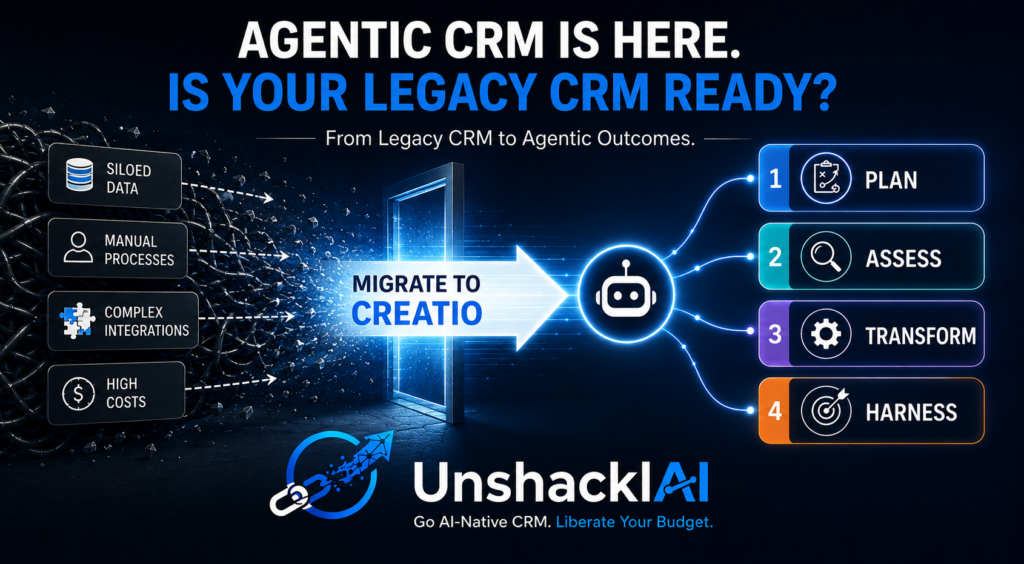
Ask any enterprise IT leader why a CRM migration keeps sliding to next fiscal year, and the answer almost always comes down to one of two things: the per-seat math gets worse as the company grows, or the AI capability everyone wants requires a development team the company does not have a budget to staff.
Creatio 10x targets both directly.
- Per-Seat Cost Growth Stops Being a Planning Problem
Legacy CRM pricing models charge by the seat, and headcount growth turns into a direct, compounding licensing expense the moment a company scales. That dynamic is a well-documented reason CFOs slow-walk platform decisions, since a growth plan on paper becomes a bigger number on a renewal invoice in practice. It is also the reason so many companies approach a legacy CRM migration partner conversation only after a renewal shock, rather than on their own timeline. Under Creatio Unlimited Enterprise, that link is cut.
A finance leader modeling a three-year headcount plan is no longer modeling a three-year licensing increase alongside it, which removes one of the two hardest objections in any migration business case.
- AI No Longer Requires a Developer to Configure
The second delay is more operational than financial.
Most organizations that want agentic AI inside their CRM discover that building it requires a developer, a backlog slot, and a multi-week wait behind whatever the engineering team is already prioritizing. Creatio AI Twin removes that dependency for the majority of use cases a business team actually needs: a sales rep building a personal follow-up agent, a service rep building a triage assistant, a marketing analyst building a campaign summarizer. None of that requires a ticket to IT anymore.
The technical architecture underneath a Creatio 10x implementation partner engagement still matters for the complex, fully autonomous agents that need governance and cross-system access, but the everyday agent no longer waits in a developer queue.
Enterprise data migration projects already carry enough risk on their own.
Research on enterprise data migrations puts the share that run over budget or over schedule above 80 percent, and CRM implementations specifically fail at a rate estimated between 30 and 63 percent, almost always for reasons that have nothing to do with the destination platform’s capability. Removing per-seat cost growth and the developer dependency does not eliminate migration risk, but it does eliminate two of the reasons that risk gets used as an excuse to never start.
What Working With a Creatio 10x Implementation Partner Looks Like in Practice
A platform capability and a successfully realized platform capability are two different things, and the gap between them is exactly where a legacy CRM migration partner earns its role.
In practice, a Creatio 10x implementation partner engagement tends to follow a consistent shape, regardless of which legacy system a company is moving off of.
- Assessment before architecture. Before anyone touches Creatio AI Twin configuration, the existing environment gets mapped: what data lives where, which workflows are actually used versus inherited from a prior implementation, and which AI use cases matter most to the business rather than to the vendor’s demo script.
- Phased migration, not a single cutover. Enterprise migrations that try to move everything in one weekend are the ones that show up in the failure statistics. A disciplined Creatio 10x implementation partner sequences the move by function or by business unit, validating each phase before the next one starts.
- Governance built in from day one. Because Creatio AI Twin lets any employee build an agent, the partner’s job includes setting the approval rules, access boundaries, and audit visibility before those agents go live, not after the first one causes a problem.
- Change management as a deliverable, not an afterthought. Adoption is the difference between a migration that pays for itself and one that gets quietly worked around. Training for the people actually building agents through Creatio AI Twin matters as much as the technical build.
B-TRNSFRMD’s role in these engagements sits squarely in that gap between platform capability and realized outcome.
As a Creatio 10x implementation partner, the work is less about selling the platform and more about making sure the Unlimited Enterprise model and Creatio AI Twin actually change how a specific organization operates, not just what its contract allows.
That distinction, between what a platform can do and what an organization is actually configured to do with it, is the same one that determines whether any legacy CRM migration partner relationship succeeds or quietly stalls six months after go-live.
Your Next Step
If per-seat cost growth or a missing developer has been the quiet reason your CRM migration keeps sliding, Creatio 10x is worth a direct conversation rather than another internal debate.
Ready to find out what this means for your environment?
The fastest way to know if it applies to you is a direct assessment with a legacy CRM migration partner that has already run this playbook. Book a free assessment to see how Creatio 10x changes your migration math.
Frequently Asked Questions
- What Is Creatio 10x?Creatio 10x is the latest major release of the Creatio CRM and workflow platform, built around two capabilities: Creatio AI Twin, which lets any employee build an AI agent through plain-language conversation with no code required, and Creatio Unlimited Enterprise, an operating model that removes limits on users, agents, and scale within a single contract.
- What Does Creatio's Unlimited Enterprise Model Mean for Pricing?Creatio Unlimited Enterprise decouples cost from per-seat and per-agent growth, meaning organizations do not automatically face a licensing renegotiation when headcount grows or when they deploy more AI agents. For companies used to legacy CRM per-seat pricing, this changes how a multi-year growth plan gets budgeted, since scale no longer compounds the license line item the way it historically has.
- Do You Need a Creatio 10x Implementation Partner to Migrate From a Legacy CRM?Technically no, but most organizations benefit from one. A Creatio 10x implementation partner handles the parts that cause migrations to stall: mapping the existing environment, sequencing a phased rollout instead of a single cutover, and setting governance around Creatio AI Twin before employees start building agents. The platform capability is there either way. A partner determines how quickly and safely you realize it.
- How Is Creatio AI Twin Different From a Standard AI Copilot?Most copilots answer questions or draft text inside an existing workflow. Creatio AI Twin goes further by letting any employee describe a need in plain language and have a working AI agent built and deployed, not just a suggestion generated. It operates within the same governance framework as Creatio AI Studio, so agents built by frontline employees still respect existing access rights and approval policies.
- Can Creatio Unlimited Enterprise Work Alongside an Existing Legacy CRM During Migration?Yes. Most legacy CRM migration partner engagements use a phased approach rather than a single cutover, which means Creatio Unlimited Enterprise can run in parallel with a legacy system while specific functions or business units migrate over time. This reduces the operational risk of moving everything at once and lets teams validate each phase before the next one starts.