| TL;DR
A structured Freshdesk optimization healthcare engagement replaced that setup with an omnichannel model built for AI-assisted resolution, not just faster ticket logging. The playbook behind it doubles as a Freshdesk CSAT improvement healthcare blueprint, since faster resolution and fewer repeat calls are exactly what moved patient satisfaction here. If your Freshdesk environment has been live for a while but the metrics have flatlined, treat this as a diagnostic checklist, not a sales pitch. |
Here is an uncomfortable truth for healthcare IT leaders holding their Freshdesk contract like a life raft: the platform was never the bottleneck. The configuration was. Every vendor deck promises that AI will fix patient support. Most of those decks are wrong, not because the technology fails, but because they skip the unglamorous part where somebody actually configures it around how a real patient support team works. This is the story of what happens when a Freshdesk optimization healthcare engagement does that work properly.
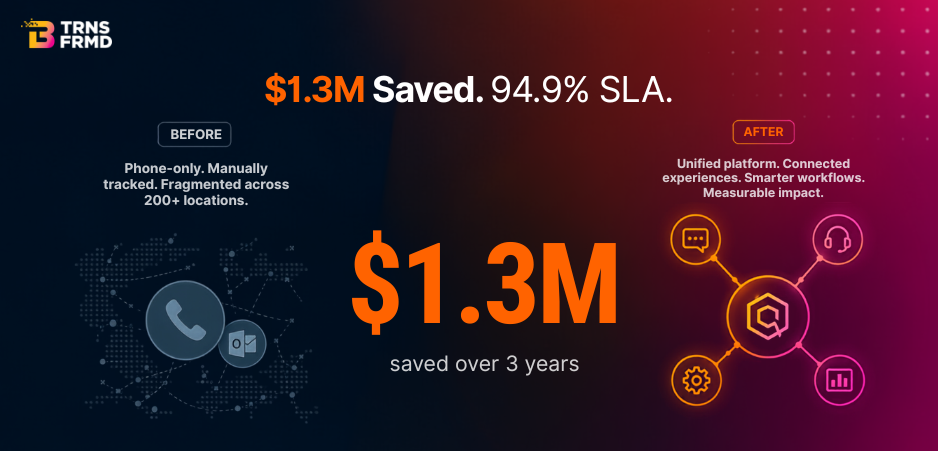
A 200-location U.S. urgent care network was running its patient financial services support almost entirely by phone, with email handled manually through Outlook and no tracking behind any of it. A Freshdesk optimization engagement rebuilt that operation from the ground up.
Three years later, the network is $1.3 million ahead of where the old system would have left it, sustaining SLA compliance north of 94 percent at a ticket volume the phone-only model could never have survived.
The Situation: Fragmented Support Across 200+ Locations
Growth is supposed to be the good problem. For this urgent care network, it had become an actual problem. As the network expanded past 200 locations, its patient financial services team was still running support the way a much smaller organization would: phone calls routed through Five9, and everything else handled by whoever happened to check the shared Outlook inbox that day.
Four structural gaps defined the pre-transformation state. Support channels were restricted almost entirely to phone, with email tracked nowhere. Workflows were manual from end to end, so reminders and follow-ups depended on someone remembering to send them. Self-service did not exist in any form, which meant even the simplest question, like a clinic’s hours or location, generated a phone call. And leadership had no 360-degree view of what was actually happening in the contact center, because the reporting structure had never been built to answer that question.
None of this is unusual. It is, in fact, the default state of most healthcare support operations that scale faster than their tooling did, and it is exactly the environment where customer support AI healthcare initiatives tend to underdeliver, because nobody fixed the foundation first.
What made this account different is what happened next: a real assessment, followed by a real rebuild, instead of another dashboard nobody would use.
What the Assessment Found: The Three Configuration Failures
Every Freshdesk optimization healthcare engagement starts with diagnosis, not deployment.
In this account, the diagnosis surfaced three specific failures, and all three would sound familiar to almost any healthcare IT leader running a legacy contact center model. Each one is also a direct lever for Freshdesk CSAT improvement healthcare work, since every failure below maps to a specific reason patients were waiting longer than they should have been.
- Channel Fragmentation Built for a Smaller Network
Phone through Five9 and manual email through Outlook were the entire channel strategy. There was no chat, no patient portal, and no unified view of a patient’s history across those two disconnected paths. Every new location added volume to a model that already could not keep up.
- No Automation Layer Behind the Tickets
Nothing routed itself. Nothing reminded anyone of anything. Specialized teams, Coding, AR and Billing, and Workers Comp among them, relied on manual assignment to get the right ticket to the right desk, which meant delays were baked into the process before an agent ever touched the case.
- No Way to See the Problem, Let Alone Fix It
The existing resolution coding system used just 19 broad codes, nowhere near granular enough to identify a systemic billing issue or a registration pattern before it generated a wave of calls. Leadership was managing a 200-plus location operation without the visibility to know what was actually driving contact volume, let alone fix it upstream.
Put those three failures together and the pattern is obvious: this was never a technology gap.
Freshdesk could already do more than the organization was using it for, and no customer support AI healthcare feature could have overcome that on its own. The gap was configuration, and configuration is exactly what a properly scoped Freshdesk optimization healthcare engagement is built to close.
The Engagement: What Changed and In What Order
B-TRNSFRMD‘s delivery approach runs on a structured, phased cadence designed to show measurable progress inside a single quarter rather than a year-long transformation roadmap nobody can point to results from. For this account, that cadence broke down across three phases.
Discovery and Strategic Design
The team mapped existing workflows against the future-state design, documenting exactly where the Outlook-based email process and the phone-only model were creating bottlenecks. From that mapping came the architecture: a unified omnichannel patient support model integrating Freshdesk, Freshchat, Genesys, and Injixo into a single ecosystem, along with a custom KPI and resolution-code framework built for actual root-cause visibility rather than surface-level activity reporting.
Agile Implementation and Integration
This was the build phase, delivered modularly so the organization saw value accumulate rather than waiting for a single big-bang launch. Freshdesk went live for unified ticket management, with a custom three-tier resolution code system expanding from 19 to 30 codes. Freshchat went live with four region-specific chatbots handling round-the-clock resolution for routine questions, with a deliberately engineered handover so complex cases moved cleanly from bot to human agent. Telephony migrated to Genesys with a multi-level IVR tree routing calls by skill group, and Injixo came online for workforce management so staffing matched real-time demand instead of a fixed schedule. Underneath all of it, the team built 63 workflow automations handling triage, assignment, and patient notifications, which is the layer that turned a collection of new tools into an actual system.
Change Management and Continuous Improvement
New technology that nobody knows how to use is just new technology. This phase covered dedicated training for agents, supervisors, and administrators, plus the first round of data-driven tuning: refining chatbot responses against real interaction data and standing up real-time dashboards so SLA performance became something leadership could actually monitor.
Every phase was scoped as a Freshdesk CSAT improvement healthcare lever in its own right, not just a technical migration to check off a project plan.
The Outcomes: $1.3M Savings, 94.9% SLA Compliance, 63 Workflows Automated
- $1.3 million saved over three years, achieved through consolidating technology spend and eliminating the inefficiencies of the phone-only model.
- 94.96 percent resolution SLA sustained across more than 17,234 tickets, a scale the legacy system had no realistic path to supporting.
- 63 automated workflows now handle triaging, assignment, and notifications that used to depend entirely on someone remembering to act.
- 1,910 bot chats resolved in a single month across four region-specific chatbots, deflecting volume before it ever reached an agent.
- Resolution codes expanded from 19 to 30 across three tiers, giving leadership the granularity to catch systemic billing or registration issues before they generate a wave of calls.
- Hold time down 11 seconds on average, with outbound talk time down 3 seconds and outbound hold time down 15 seconds, both driven by agents having patient information available without repetitive data entry.
Add those up and the story is not really about a phone system getting replaced. It is about what happens when customer support AI healthcare deployments are built on a foundation designed for them, instead of layered on top of whatever happened to be running before.
The hold-time and handoff numbers above are, in the end, a Freshdesk CSAT improvement healthcare story told through operational metrics instead of a survey score.
*These figures are B-TRNSFRMD client engagement data from this specific 200-plus location urgent care network. They are not vendor marketing benchmarks, and they are not projected or modeled numbers.
What This Means for Healthcare IT Leaders
Patient experience stopped being a purely clinical metric a while ago. For an operation running patient financial services across 200-plus locations, it is now a financial metric with a number attached to it, and this account proves the number can be a big one.
Three implications matter beyond this specific engagement.
- First, consolidating the agent interface prevents burnout by removing repetitive data entry, which is a retention issue as much as an efficiency one.
- Second, granular resolution coding lets management catch systemic problems, a billing error, a registration gap, before they generate the next spike in call volume, turning support from reactive to proactive.
- Third, and most important for any CFO watching headcount, round-the-clock chat deflection and self-service let a network add locations without adding agents at the same rate. That is the entire argument for treating Freshdesk optimization healthcare work as a strategic investment rather than a support-desk line item.
The organizations getting this right are not spending more than everyone else on customer support AI healthcare tooling. They are spending the same money more deliberately, on configuration instead of on more licenses, and treating every rollout as a Freshdesk CSAT improvement healthcare project with a measurable owner, not a one-time deployment.
Your Next Step
If any part of the situation described above sounds like your own environment, the fastest way to find out where you actually stand is a direct assessment, not another internal audit that competes for attention with everything else on your team’s plate.
Book a Free Assessment to know more on how B-TRNSFRMD approaches Freshdesk optimization for healthcare organizations.
Frequently Asked Questions
- How can healthcare organizations improve Freshdesk CSAT?Freshdesk CSAT improvement healthcare work starts with automating triage and assignment so tickets reach the right specialized team on the first attempt, then layering in self-service chatbots to resolve routine questions instantly. Granular resolution coding also matters, since it lets teams fix root causes before they generate repeat contacts. Faster resolution and fewer repeat calls are what actually move CSAT, not a chatbot alone.
- What does Freshdesk optimization look like in healthcare?In practice, Freshdesk optimization healthcare engagements combine unified ticket management, region-specific self-service chatbots, intelligent call routing, and workflow automation for triage and notifications. It is customer support AI healthcare deployment done properly: replacing fragmented, phone-only, manually tracked support with one connected system that billing, coding, and patient services teams can all work from without repetitive data entry or duplicated effort across departments.
- How long to see ROI from Freshdesk configuration changes?In this urgent care engagement, the core rebuild moved through discovery, implementation, and change-management phases in sequence, with measurable SLA and deflection gains visible almost immediately after go-live. Full financial ROI, including the $1.3 million in savings, was realized over three years as automation and self-service adoption compounded, though operational improvements like reduced hold times and faster handoffs showed up within the first few weeks.
- What's a good chatbot deflection rate for a healthcare patient support operation?Published benchmarks for healthcare AI chatbots typically range from 65% to 85% of routine contacts resolved without a human agent. In this engagement, four region-specific chatbots deflected 1,910 bot chats in a single month — volume that never reached a live agent, freeing that capacity for the cases that actually needed one.
- What is skill-based call routing, and why does it matter for healthcare contact centers?Skill-based routing sends an incoming call directly to the team equipped to handle it — Billing, Coding, or Workers Comp, for example — instead of a general queue that gets manually reassigned later. In this engagement, a multi-level IVR tree on Genesys routed calls by skill group from the first ring, which is what made the hold-time and handoff-time reductions possible in the first place.
- Can a growing healthcare network scale patient support without adding headcount at the same rate?Yes — the mechanism is self-service deflection combined with granular resolution coding. When chatbots absorb routine volume and resolution codes catch systemic issues (a billing error, a registration gap) before they generate repeat calls, a network can add locations without a proportional increase in support staff. That's the operating model this engagement was built around.