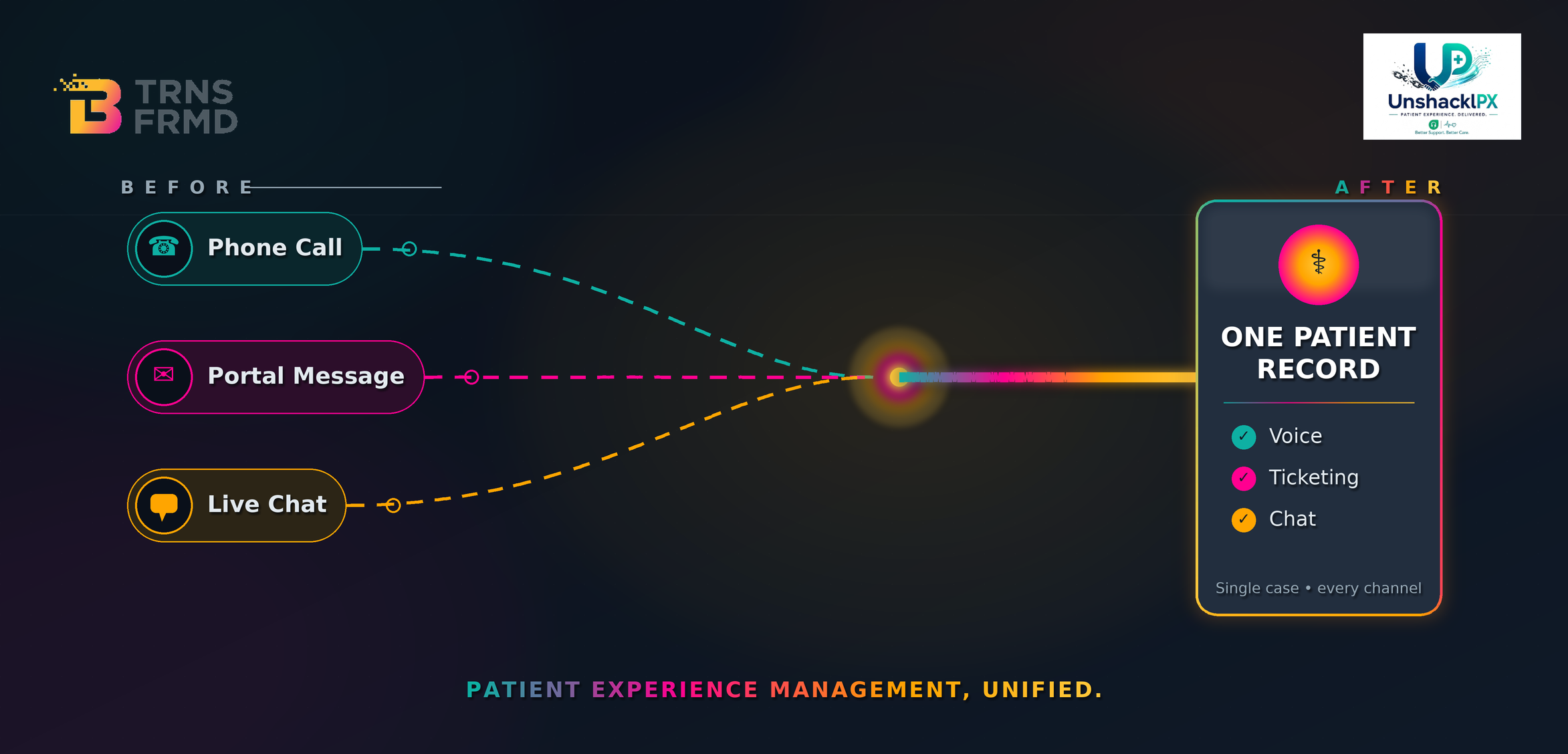
Digital transformation for healthcare, at the support desk, means retiring disconnected ticketing, phone, and portal tools in favor of one AI-native platform where every patient touchpoint writes to the same record. It isn’t a new phone tree or a chatbot bolted onto an old system — it’s the infrastructure that lets patient experience management, healthcare workflow automation, and patient engagement software work as one system instead of three.
Here’s a question worth sitting with: if a patient called, then emailed, then called again, would anyone on your team actually see all three? For most healthcare organizations, the honest answer is no. B-TRNSFRMD has already mapped where the hidden cost of legacy healthcare support tools actually lives — integration overhead, manual triage, AI that never gets properly activated. This is what fixing it actually looks like.
What Digital Transformation for Healthcare Actually Requires at the Support Desk
Most healthcare organizations treat digital transformation for healthcare as a front-end project — a new portal, a chatbot widget, a refreshed phone tree. At the support desk, where patients actually reach a human or an AI Agent, it requires four structural changes underneath the interface:
- One patient record across every channel. Ticketing, voice, and chat write to the same case — not three separate logs an agent has to reconcile mid-call.
- AI built in, not bolted on. An AI Agent needs native access to ticket history and resolution codes to resolve a request — not just deflect it to a human with no context.
- Automated routing and SLAs. Billing, coding, referrals, and clinical requests get sorted by rule, not by whoever on a thin team has bandwidth that day.
- Real-time reporting. Leadership sees a systemic issue — a billing pattern, a stalled queue — before it generates a wave of calls, not after.
Skeptical this is more than a slide? A 200-plus location urgent care network made this exact shift. It now runs 63 automated workflows for triage and SLAs, sustains a 94.9% resolution SLA across more than 17,234 tickets, and resolves 1,910 bot chats a month without agent involvement — cutting $1.3 million annually in the process. The full breakdown is in $1.3M Saved, 94.9% SLA: Inside One Healthcare Network’s Freshdesk Optimization Overhaul, and it’s proof that healthcare workflow automation isn’t theoretical.
Where Patient Experience Management Breaks Down Today
Patient experience management is supposed to be one discipline. In most healthcare organizations, it’s split across a ticketing tool, a phone system, and a portal that don’t talk to each other — and the cracks between them are where patients feel it most:
- Phone-only intake with no unified view across channels, so a patient who emails and then calls has to explain themselves twice
- Referral leakage between PCP and specialist because no system owns the handoff
- Manual eligibility and billing routing that surfaces errors after the claim goes out, not before
- No structured post-discharge follow-up — reminders depend on someone remembering to send them
- Reporting thin enough that a systemic issue only surfaces after it’s already generated a wave of complaints
Recognize your organization in that list? You’re not alone — and it’s exactly what B-TRNSFRMD’s field guide, The Real Cost of a Broken Patient Support Experience, was built to quantify: the actual cost in calls, patient leakage, and reimbursement. Closing these gaps is what an omnichannel patient experience management approach exists for — one workspace, one patient view, every channel. Organizations that get it right see average handle time drop by 29% and first-contact resolution climb to 76%.
Patient Engagement Software vs. Truly Unified Patient Support
The two terms get used interchangeably, and they shouldn’t be. So which one does your organization actually have?
Patient engagement software is usually a point solution — appointment reminders, portal messaging, satisfaction surveys. A truly unified patient support platform is something else entirely: the system of record for every patient interaction, with AI, routing, and reporting built around the full journey, not just the outreach layer.
| Patient Engagement Software | Unified Patient Support Platform | |
| Scope | Appointment reminders, portal messaging, surveys | Ticketing, voice, and chat sharing one case record |
| AI | Add-on chatbot, configured and licensed separately | AI Agents with native access to ticket and resolution history |
| Reporting | Engagement metrics only | Real-time CSAT, SLA, and deflection dashboards |
| Who owns it | Marketing / patient engagement team | Support, PX, and IT working from the same platform |
A Freshdesk omnichannel patient support build is the clearest example of the difference — every channel treated as one continuous conversation instead of three separate logs to reconcile. Across B-TRNSFRMD’s omnichannel CX engagements, clients have seen an average 38% improvement in CSAT and 41% ticket deflection via AI within 90 days of proper configuration.
Healthcare Workflow Automation Across Provider Networks, Pharma, and Behavioral Health
Healthcare workflow automation isn’t one template stretched across every buyer — what works for a 200-location provider network looks nothing like what a pharma inquiry line needs. B-TRNSFRMD builds it around three distinct ICPs, each with its own support gap and its own compliance reality:
| ICP | Where the Support Gap Shows Up | What Healthcare Workflow Automation Fixes |
| Healthcare Provider Networks | Phone-only scheduling, referral leakage, billing disputes across locations | Omnichannel ticketing, automated referral routing, self-service billing |
| Pharma & Life Sciences | HCP inquiry volume and adverse-event reporting under strict audit trails | AI triage with compliance-grade documentation and structured escalation paths |
| Behavioral & Mental Health | High-sensitivity intake and the need for consistent, risk-aware follow-up | Risk-tiered, behavior-triggered outreach and unified care-coordination case views |
Every one of these paths runs on B-TRNSFRMD’s PATH TO OUTCOME™ CX transformation methodology, and every one lands in the same place: fewer patients repeating themselves, fewer requests stuck between departments, and a support team that scales without hiring in lockstep with every new location or new drug program.
Where does this actually get built? UnshacklPX, B-TRNSFRMD’s AI-native patient support platform — a three-phase migration (Assess, Migrate, Activate) run at zero patient-facing downtime, typically 12–16 weeks from kickoff to full team adoption, with 100% adoption reached within 90 days of go-live across B-TRNSFRMD’s Freshdesk implementations.
Frequently Asked Questions
- What counts as digital transformation for a healthcare support team?For a healthcare support team, digital transformation for healthcare means moving off disconnected ticketing, phone, and portal tools onto one AI-native platform where every patient touchpoint shares the same record. It includes unified case history, AI Agents with native access to that history, automated routing and SLAs, and real-time reporting leadership can actually act on — not just a new front-end.
- Is patient engagement software the same as patient experience management?No. Patient engagement software usually covers a narrow slice — appointment reminders, portal messaging, satisfaction surveys. Patient experience management is the broader discipline: every channel a patient uses to reach an organization, unified into one record, with routing, automation, and reporting built around the full journey, not just the outreach layer.
- What is healthcare workflow automation, in practice?Healthcare workflow automation is the rule-based and AI-driven handling of repeatable support tasks — routing a billing inquiry to the right team, triaging a refill request, flagging a stalled ticket before it becomes a complaint — without a person doing it manually every time. It runs differently for a provider network, a pharma HCP inquiry line, and a behavioral health intake desk, because the compliance and sensitivity requirements differ.
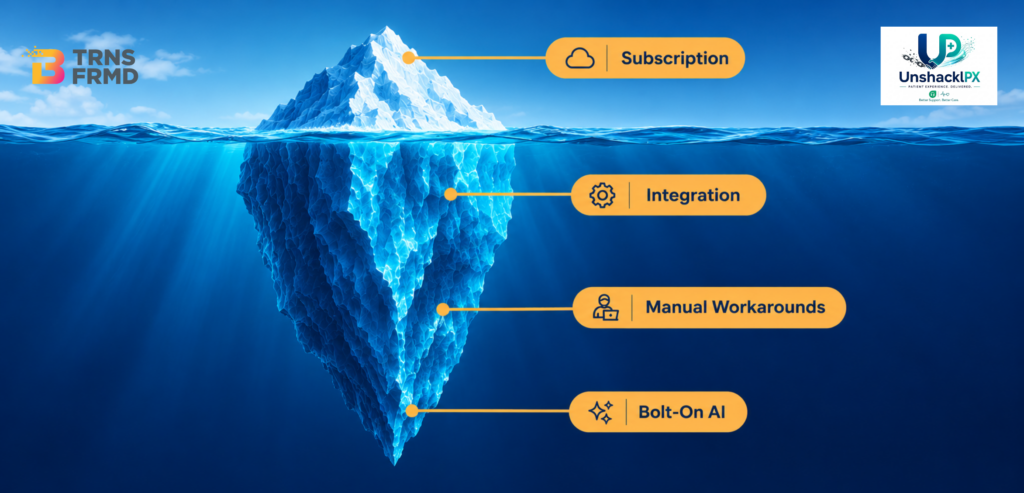
- How does digital transformation for healthcare reduce support costs?It reduces cost mainly by closing the gap between the subscription line and everything a fragmented stack quietly costs in integration labor, manual workarounds, and turnover. One 200-plus location urgent care network consolidated its stack this way and saved $1.3 million annually while sustaining a 94.9% resolution SLA — savings that came from architecture, not a cheaper subscription.
- Is Freshdesk HIPAA-compliant for healthcare support?Yes, when configured with the appropriate HIPAA compliance package and a signed Business Associate Agreement in place. That configuration needs to be built in from the assessment phase, not added afterward — this matters most once patient financial and clinical data start flowing through chat and ticketing together.
- How long does a healthcare support digital transformation take?Timelines vary by starting complexity, but a full migration and AI activation for a healthcare support platform typically runs 12–16 weeks, covering assessment, staged migration with zero patient-facing downtime, and AI activation — not just a platform swap.
Ready to Close the Gap?
If any part of this sounds like your environment, the fastest way to find your real number is a direct conversation — not another internal audit competing for attention with everything else on your plate.